
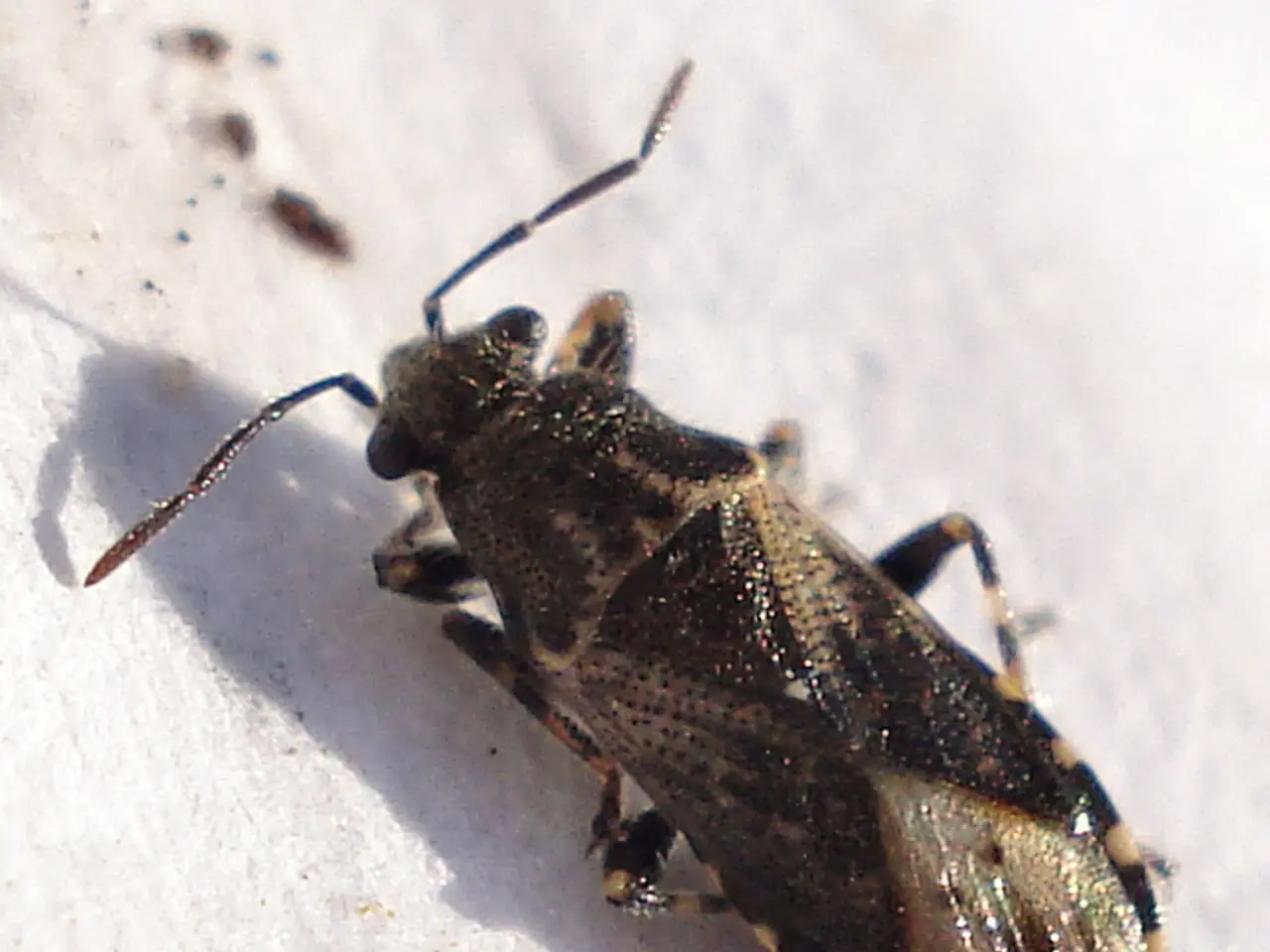
Discovered: Radioactive Wasps' Nest at Former Nuclear Bomb Production Site in US
Radioactive Wasp Nest Discovered at Savannah River Site
A radioactive wasp nest was recently discovered near liquid nuclear waste storage tanks at the Savannah River Site in South Carolina. The nest, found on July 3, had a radiation level ten times higher than federal regulations allow [1].
Despite the discovery, no wasps were found after the nest was removed. Tom Clements, executive director of Savannah River Site Watch, expressed concern about the lack of information regarding the source of the radioactive waste and potential leaks from the waste tanks [2].
According to Clements, understanding the type of wasp nest could help pinpoint the contamination's source. Different wasp species use different materials for their nests—some use dirt, others use wood fibers or plant material. This detail could indicate whether the contamination was from soil, airborne particles, or surface residues [1].
The nest was found near tanks where liquid nuclear waste is stored, and officials stated the nest's radioactivity likely came from "onsite legacy radioactive contamination," meaning residual radioactivity remaining from past site operations rather than an active leak from the waste tanks [1][3].
The Savannah River Site, opened in the early 1950s, was primarily used to manufacture plutonium pits for nuclear bombs during the Cold War. However, its focus has since shifted toward making fuel for nuclear plants and clean up [4]. The site currently has 43 underground tanks in use, with eight having been closed [5].
The site has generated over 165 million gallons of liquid nuclear waste, reduced to about 34 million gallons through evaporation. The tank farm at the Savannah River Site is inside the facility's boundaries [5].
Identifying the wasp species and their nesting materials is critical in tracing how and where the radioactive contamination persists onsite. This behavioral insight allows environmental monitoring teams to better understand contamination vectors and assess potential exposure routes at the Savannah River Site [1].
Workers at the site sprayed the nest with insect killer, removed it, and disposed of it as radioactive waste [1]. Despite the discovery, operations at the site continue as normal, with no immediate threat to the public or workers reported. The incident serves as a reminder of the ongoing challenges in managing and containing nuclear waste.
[1] Savannah River Site Watch. (2021). Radioactive wasp nest found at Savannah River Site. Retrieved from https://savannahriversitewatch.org/2021/07/05/radioactive-wasp-nest-found-at-savannah-river-site/
[2] The State. (2021). Radioactive wasp nest found at Savannah River Site. Retrieved from https://www.thestate.com/news/local/article252789421.html
[3] Post and Courier. (2021). Radioactive wasp nest found near tanks at Savannah River Site. Retrieved from https://www.postandcourier.com/news/local/radioactive-wasp-nest-found-near-tanks-at-savannah-river-site/article_e832b79e-57b4-11eb-881a-5b28c4c259b2.html
[4] Savannah River Nuclear Solutions. (n.d.). Our history. Retrieved from https://www.srns.com/about/our-history
[5] Nuclear Regulatory Commission. (n.d.). Savannah River Site. Retrieved from https://www.nrc.gov/sites-data/srps/srs/default.asp
- The radioactive wasp nest discovered at the Savannah River Site raises concerns about the potential long-term impacts of industry's interaction with both the environment and climate-change, especially since the site has been used for nuclear bomb production and energy production.
- Given the Savannah River Site's history of manufacturing plutonium pits during the Cold War and its current focus on nuclear plant fuels, it is crucial to develop and implement effective solutions for managing and reducing radioactive waste in the business sector, particularly within the energy industry.
- As the Savannah River Site continues to contribute to the energy supply, it is essential that political leaders and industry officials collaborate to fund environmental-science research and forge innovative solutions to address the complex problem of radioactive waste contamination and its effects on the environment, such as climate-change.
- Enhancing the understanding of wasp behavior and their role in the ecosystem within the Savannah River Site can lead to valuable insights about potential environmental threats, providing opportunities for the science and finance communities to collaborate on developing sustainable solutions for the future of the energy industry, the environment, and the global climate-change challenge.




