
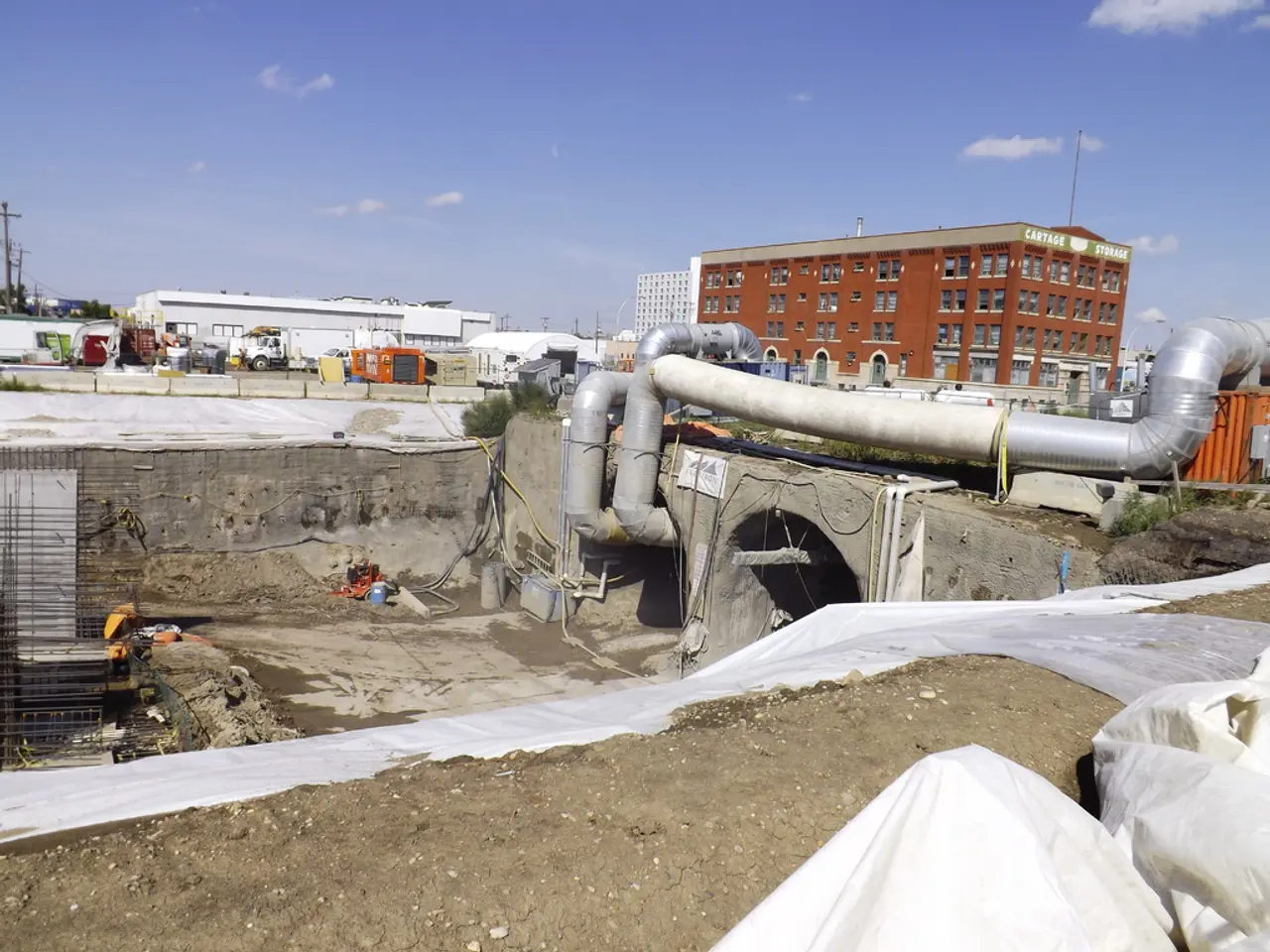
Egypt's colossal $565 billion construction project pipeline is set to reshape the country's economy.
Egypt's construction sector is experiencing a significant growth spurt, with the country's Vision 2030 serving as a guiding force. The sector's growth is driven by a diverse range of projects, including foundational works, residential, offices, commercial, and large-scale public infrastructure like energy and transport.
According to Knight Frank's research, the pipeline of future projects in Egypt stands at a staggering $565.5 billion. This includes chemical plants, power generation, and transport infrastructure, with flagship urban development projects like the New Administrative Capital and New Alamein taking centre stage.
The current construction activities cover a broad spectrum, from traditional residential and commercial buildings to large-scale energy and transport mega-projects. Notably, over 51% of these future developments are still in the planning phase, while approximately 39% are in the design phase. These early stages present opportunities for specialized firms in feasibility, design, and advisory services.
The robust growth in the construction sector is tied to Egypt's rapid population growth and economic competitiveness ambitions. As a result, investors are advised to work with experienced local consultants to navigate regulatory frameworks and supply chain dynamics in Egypt.
In terms of property prices, build costs for apartments in Egypt range from $720 to $1,270 per square metre (psm), villas up to $1,310 psm, shell-and-core offices from $565 to $775 psm, and fitted offices up to $1,210 psm. In commercial real estate, New Cairo holds nearly 73% of Cairo's current and upcoming office stock, with average prices for commercial properties reaching EGP 274,000 psm, and premium office space reaching as high as EGP 466,000 psm.
In Q2 2025, the average unit price for residential properties in Sheikh Zayed was EGP 115,000 psm, and EGP 98,000 psm in New Cairo. Residential prices in Egypt have climbed over 16.5% year-on-year (YoY).
The construction sector's growth has propelled Egypt to the third-largest construction market in the Middle East and North Africa (MENA) region, following Saudi Arabia and the UAE. Currently, $120 billion worth of construction projects are underway in Egypt.
However, investors should be aware of key risks such as cost inflation, currency volatility, and public spending limits. Despite these challenges, strong returns are possible in residential and commercial property segments, especially within the New Administrative Capital and coastal developments.
Partnering locally is crucial for success in Egypt's construction market due to the need for on-ground insight into regulations, procurement, and culture. As the construction sector continues to grow, Egypt presents a fertile ground for investment, particularly in the chemical, power, and transport sectors, with substantial long-term growth expected in these areas as part of Egypt's strategic infrastructure expansion.
- The construction sector's growth in Egypt, driven by Vision 2030, has propelled the country to become the third-largest construction market in the MENA region.
- With a pipeline of future projects worth $565.5 billion, Egypt offers opportunities for specialized firms in feasibility, design, and advisory services.
- In the real estate sector, build costs for apartments range from $720 to $1,270 per square metre, while commercial properties in New Cairo reach an average price of EGP 274,000 per square metre.
- Investors should partner locally to navigate regulatory frameworks and supply chain dynamics, and should be aware of risks such as cost inflation, currency volatility, and public spending limits, but strong returns are possible in residential and commercial property segments.




