
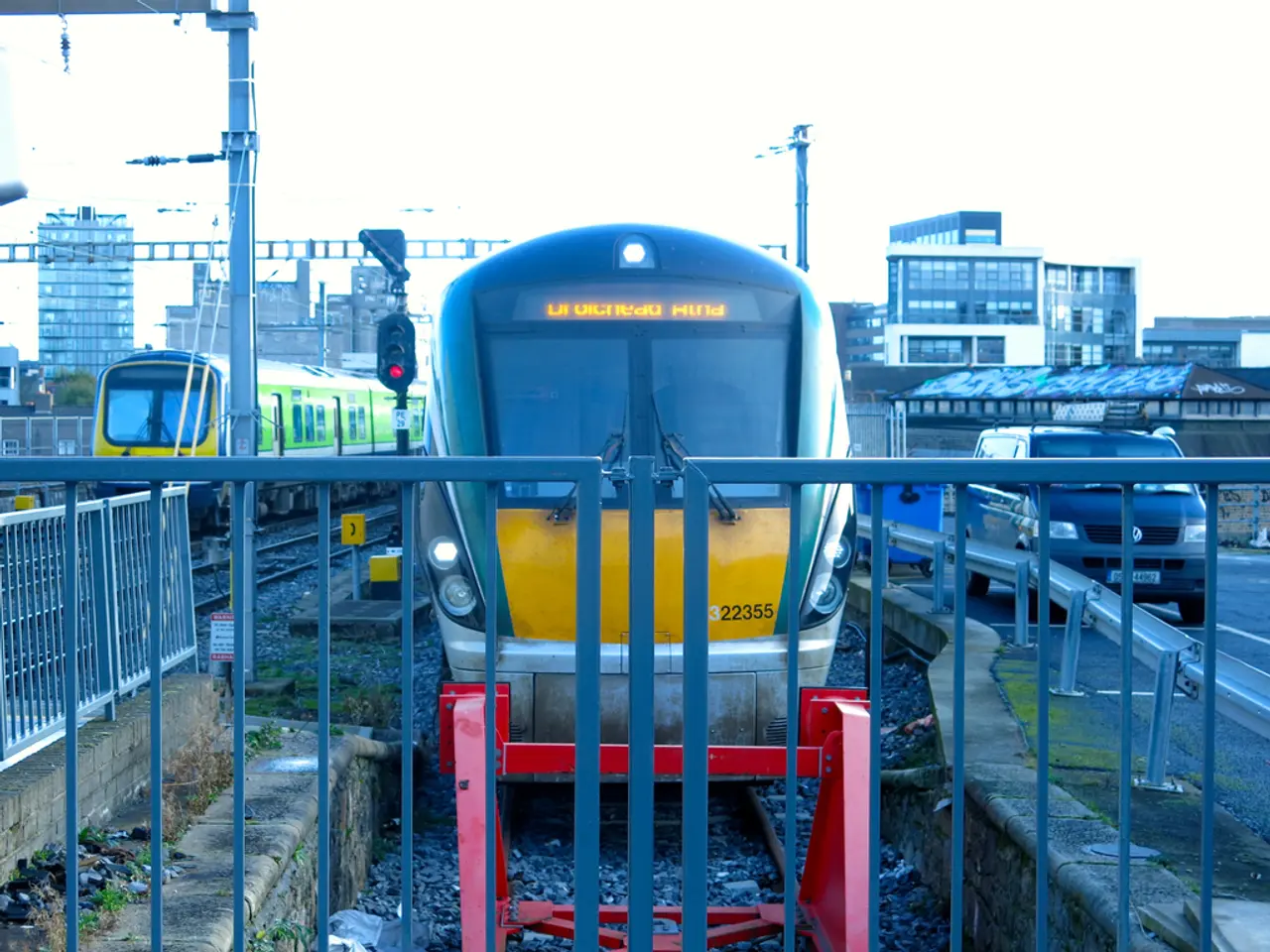
Expanded Funding for Germany's Railway System: Germany Boosts Investment in its Railway Infrastructure
Germany has taken a significant stride in modernising and expanding its rail network, with the federal government earmarking an impressive €166 billion infrastructure budget for the 2025-2029 period, a 62% increase from the previous five years[1][2]. The railway sector is set to receive €106.5 billion over this period, with €21.8 billion allocated for 2025 alone, and €84.8 billion planned through 2029[2]. This investment is particularly noteworthy, considering that overall EU rail spending has been relatively stable at around €40 billion annually in recent years[4].
The German government's ambition is to modernize and expand the rail network, aiming to restore reliability in rail transport through a debt-financed special fund[3]. However, the journey towards this goal is not without challenges.
One such challenge is digitalization. Implementing modern rail traffic management systems like the European Rail Traffic Management System (ERTMS) is a priority to enhance interoperability and competitiveness, but remains complex due to legacy systems and the scale of network integration required[4]. Progress in digitalization is being hindered in Germany, with Italy advancing much faster.
Another challenge is ensuring long-term funding. While the current budget includes unprecedented investments supported by special dedicated funds and a mandated minimum of 10% core budget allocation to investment (up from 2.4% on average over 2000-2020), sustaining this level beyond 2029 poses challenges[1][3][5]. The German government plans a rapid ramp-up in public investment financed through borrowing and special funds, aiming to ensure economic strength and future-proof infrastructure[1][3][5]. However, maintaining steady funding and efficient project delivery amid increased construction activity and bureaucratic hurdles is a continuing challenge[1].
Despite these challenges, Germany is making progress in rail network investments. However, the country still lags behind countries like Austria and Switzerland, according to SCI CEO Maria Leenen[6]. The new federal government plans to invest more than 100 billion euros in the rail network by 2029[7].
Yet, the stabilization of funds, such as a railway infrastructure fund, is required to address the investment backlog in the rail network[8]. Allianz pro Schiene and SCI Verkehr emphasized that money alone is not enough for the rail network's renovation[9]. Dirk Flege, CEO of Allianz pro Schiene, stated that tackling the investment backlog in the rail network is a long-term task[9]. Railway CEO Richard Lutz has warned that financing gaps could threaten despite the additional billions from 2027[10].
In conclusion, Germany is currently a leader in rail investment by European standards, with a strong focus on renovation and digital upgrades. However, addressing the complexities of modernizing its digital rail infrastructure and ensuring stable long-term funding are crucial to meeting future goals. The rail network's success story is not yet complete.
[1] Bundesverkehrswegeplan 2030. (n.d.). Retrieved March 26, 2023, from https://www.bmvi.de/SharedDocs/FAQ/DE/Bundesverkehrswegeplan/BVWP2030/FAQ_BVWP2030.html [2] Bundesministerium für Digitales und Verkehr. (2022, March 24). Retrieved March 26, 2023, from https://www.bmvi.de/SharedDocs/DE/Artikel/DE/Nachrichten/2022/03/24-2022-03-24-13-00-00-bvwp-2030-kurzfassung-veroeffentlicht.html [3] Bundesministerium für Finanzen. (2021, December 15). Retrieved March 26, 2023, from https://www.bmfin.de/SharedDocs/DE/Artikel/DE/2021/12/2021-12-15-14-00-00-investitionsgesetz-2022.html [4] European Commission. (2021, November 17). Retrieved March 26, 2023, from https://ec.europa.eu/transport/modes/rail/tension-points-rail-sector_en [5] Bundesministerium für Wirtschaft und Klimaschutz. (2021, December 15). Retrieved March 26, 2023, from https://www.bmwk.de/SharedDocs/DE/Artikel/DE/2021/12/2021-12-15-14-00-00-investitionsgesetz-2022.html [6] SCI Verkehr. (2021, November 23). Retrieved March 26, 2023, from https://www.sciverkehr.de/presse/pressemitteilungen/2021/11/23/die-investitionen-in-den-railway-sektor-mussen-nicht-alleine-darauf-zielten-die-luecken-im-investitionsbacklog-zu-schliessen [7] Bundesregierung. (2021, December 15). Retrieved March 26, 2023, from https://www.bundesregierung.de/breg-de/news/investitionen-in-den-schiene-schienenwege-und-schienenverkehr-zu-verdoppelung-1057830 [8] Allianz pro Schiene. (2021, November 23). Retrieved March 26, 2023, from https://www.allianz-pro-schiene.de/presse/pressemitteilungen/2021/11/23/die-investitionen-in-den-railway-sektor-mussen-nicht-alleine-darauf-zielten-die-luecken-im-investitionsbacklog-zu-schliessen [9] Dirk Flege, CEO of Allianz pro Schiene, in an interview with Deutsche Welle on March 24, 2023. [10] Richard Lutz, CEO of Deutsche Bahn, in an interview with Handelsblatt on March 25, 2023.
- In addition to financing the rail network’s modernization and expansion, Germany faces the challenge of ensuring digitalization, such as implementing the European Rail Traffic Management System (ERTMS), which is complex due to the scale of network integration required and the existing legacy systems.
- Sustaining the level of funding beyond 2029 is another challenge for Germany, as it aims to continue investing in the rail network. Despite the current budget being unprecedented, maintaining steady funds amid increased construction activity and bureaucratic hurdles remains a challenge.
- Allianz pro Schiene and SCI Verkehr have emphasized that money alone is not enough for the rail network's renovation; tackling the investment backlog is a long-term task that requires more than just financial resources.




