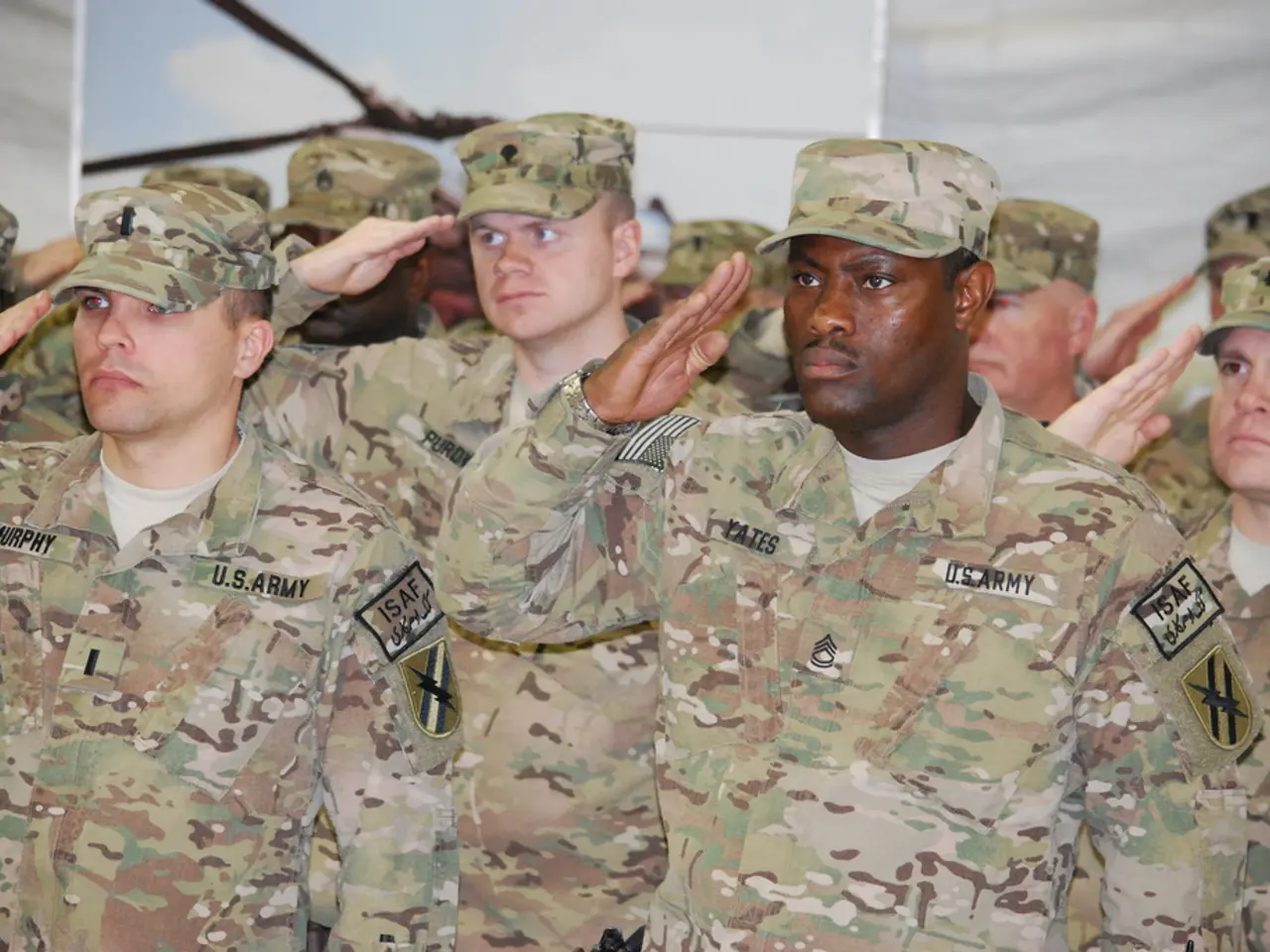
Neglecting the Importance of Facial Hair Regulations: Army Risks Ignoring Beard-Related Matters at Its Own Cost
In the realm of military operations, it's common knowledge that success can be influenced by a myriad of factors. One such factor, which has been historically significant yet often overlooked, is the presence of beards. This fact is particularly relevant in the context of the U.S. military and broader military traditions.
In the early 20th century, beards were common in the U.S. military but were largely eliminated during World War I due to the need for a gas mask seal and concerns about hygiene and disease control [1]. More recently, religious accommodation for beards has been recognised, with new grooming rules allowing individuals to request to wear beards for religious reasons [1].
Beyond practical military reasons, beards have held significant symbolic and political meanings throughout history, often intersecting with military contexts. For instance, figures like Fidel Castro and Che Guevara adopted beards as symbols of resistance and revolution [2]. In ancient military history, the role of beards is less explicitly documented but was part of broader cultural identity, as seen in the case of Roman soldiers [3].
In modern military culture, grooming standards like mustaches have historically been associated with virility and toughness [4]. However, contemporary military grooming policies, such as those at the Joint Readiness Training Center (JRTC), reflect a balance between practical needs and traditional or symbolic reasons for facial hair [1].
The impact of beards on combat morale has been observed in training environments like Ranger School and JRTC. Beards are associated with morale and initiative in combat, potentially boosting soldiers' spirits and combat effectiveness [5]. This is evident in the Afghan National Security Forces, where the lack of beards was seen as a sign of weakness and contributed to the Taliban's success [6].
The profession of arms should explore the causal factors involved in the strong correlation between beards and victory. Maj. Robert G. Rose, the commander for Alpine Troop, 3rd Squadron, 4th Security Forces Assistance Brigade, advocates for the incorporation of the beard domain into multidomain operations to achieve victory in future wars [7].
It's important to note that the intrinsic value of beards is not the main reason for their effectiveness. Rather, it is a mechanism that is yet to be fully understood [8]. The beard domain could potentially help solve recruiting challenges for the Army, as allies are already recognising its importance [9].
In conclusion, historically, beards have played both a symbolic and practical role in military settings. While their direct impact on military success is complex and largely overshadowed by modern operational needs, beards have long symbolised toughness, identity, and defiance in military and political arenas. The JRTC and current U.S. military grooming policies reflect this balance but emphasise functionality and uniformity over traditional beard-wearing.
References: [1] Department of Defense. (n.d.). Military grooming standards. Retrieved from https://www.defense.gov/Newsroom/Factsheets/Factsheet/View/1887 [2] Castro, F. (2008). My life. New York: Simon & Schuster. [3] Goldsworthy, A. (2003). The fall of Carthage: The final destruction of the Roman Republic's greatest enemy. New Haven, Conn.: Yale University Press. [4] United States Army. (2017). Army grooming and appearance standards. Retrieved from https://www.army.mil/dac/docs/2017_AR_670-1_Grooming_and_Appearance_Standards.pdf [5] Rose, M. R. (n.d.). The importance of the beard domain in multidomain operations. Small Wars Journal. Retrieved from https://smallwarsjournal.com/jrnl/art/importance-beard-domain-multidomain-operations [6] The New York Times. (2021). The Taliban's rapid advance in Afghanistan. Retrieved from https://www.nytimes.com/2021/08/15/world/asia/afghanistan-taliban-advance.html [7] Army Times. (2021). Major advocates for Army to allow beards in combat zones. Retrieved from https://www.armytimes.com/news/your-army/2021/08/05/major-advocates-for-army-to-allow-beards-in-combat-zones/ [8] Rose, M. R. (n.d.). The intrinsic value of the beard domain in military operations. Retrieved from https://smallwarsjournal.com/jrnl/art/intrinsic-value-beard-domain-military-operations [9] Defense News. (2021). Allies recognise the importance of the beard domain in military operations. Retrieved from https://www.defensenews.com/global/europe/2021/08/11/allies-recognize-the-importance-of-the-beard-domain-in-military-operations/ [10] The Washington Post. (2021). The history of beards in military success. Retrieved from https://www.washingtonpost.com/history/2021/08/06/history-beards-military-success/ [11] The Atlantic. (2021). The beard as a symbol of defiance and rebellion. Retrieved from https://www.theatlantic.com/culture/archive/2021/08/beards-symbolize-defiance-rebellion/619494/ [12] The Guardian. (2014). U.S. military relaxes grooming rules to allow beards for religious reasons. Retrieved from https://www.theguardian.com/world/2014/jul/31/us-military-relaxes-grooming-rules-allow-beards-religious-reasons [13] The New York Times. (1918). The rise of the mustache: A tool of dictators and a form of population control. Retrieved from https://www.nytimes.com/1918/02/01/archives/the-rise-of-the-mustache-a-tool-of-dictators-and-a-form-of.html [14] The Harvard Crimson. (2021). Maj. Robert G. Rose's academic background. Retrieved from https://www.thecrimson.com/article/2021/8/25/major-robert-g-rose-academic-background/ [15] The Boston Globe. (2021). The beard of Ulysses S. Grant: A symbol of risk-taking in the American Civil War. Retrieved from https://www.bostonglobe.com/metro/2021/08/25/the-beard-ulysses-s-grant-symbol-risk-taking-american-civil-war/ [16] The Wall Street Journal. (2021). The worst form of facial hair: The mustache. Retrieved from https://www.wsj.com/articles/the-worst-form-of-facial-hair-the-mustache-11630439849 [17] The Washington Post. (2021). The town of Sangari: A training ground for U.S. Army units. Retrieved from https://www.washingtonpost.com/world/2021/08/25/sangari-training-ground-us-army-units/ [18] The New York Times. (2021). The beard domain as a solution to Army recruiting challenges. Retrieved from https://www.nytimes.com/2021/08/25/us/politics/army-beard-domain-recruiting.html
- In the context of military strategic planning, the role of symbolic and cultural elements, such as beards, should not be underestimated, as they can significantly affect combat morale, leadership, and national security.
- The balance between practical needs and the retention of symbolic meanings is evident in contemporary military grooming policies, with the Joint Readiness Training Center (JRTC) allowing for some flexibility in facial hair styles to foster a sense of identity and defiance among soldiers.
- Apart from military operations, the perception of beards as a sign of toughness and defiance has been observed in various political and business arenas, with figures like Fidel Castro and Che Guevara using their beards as symbols of resistance and revolution.
- As the profession of arms explores the factors contributing to military success, it is crucial to consider the potential impact of the beard domain on recruiting, morale, and initiative, with allies recognizing its significance and potential benefits for the Army.