
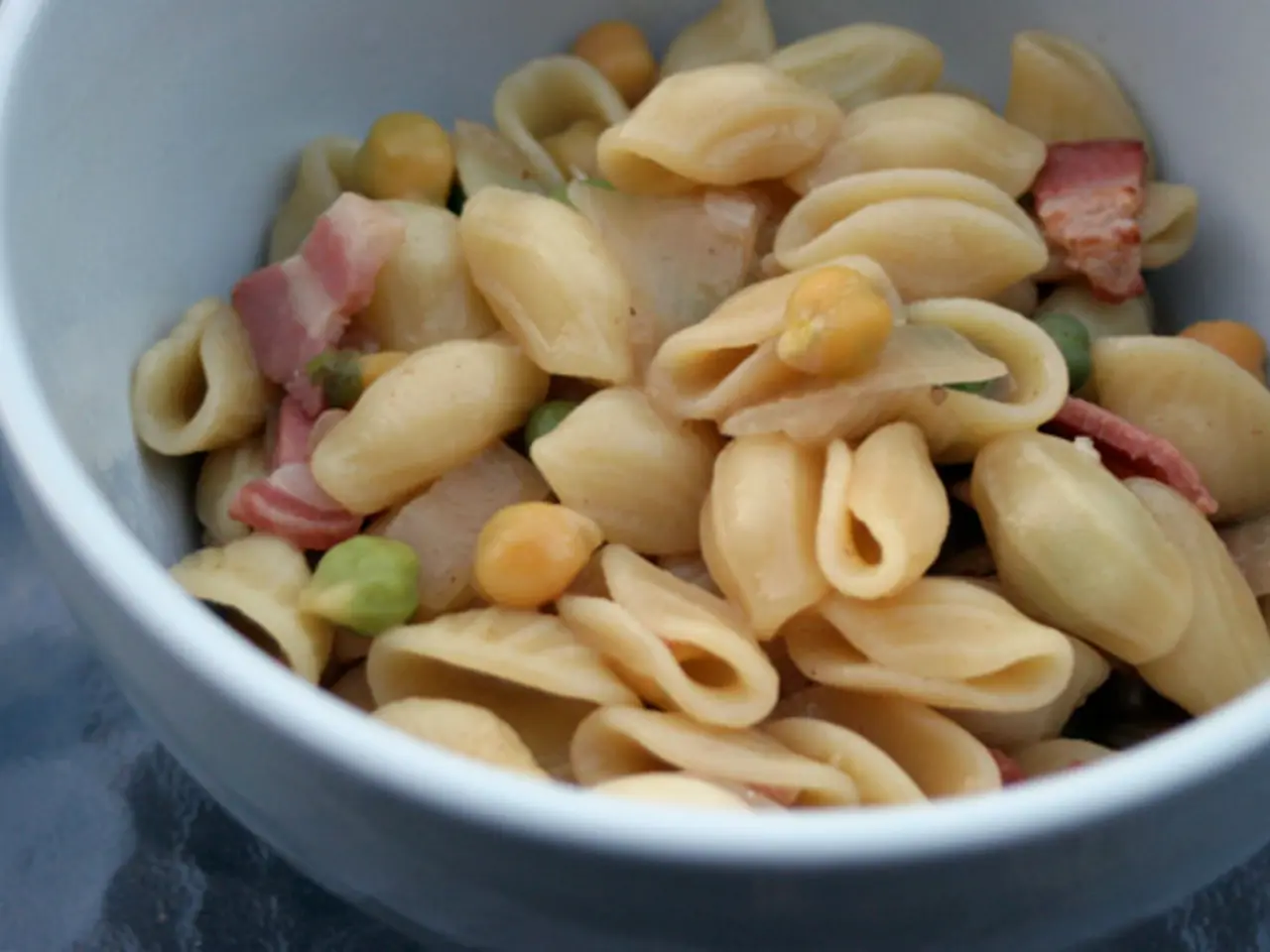
Pasta industry predicted to hit $94.7 billion by 2034, with a 4.7% annual growth rate.
Global Pasta Market Expands Rapidly, Led by Europe and Vegan Trends
The global pasta market is experiencing robust growth, with Europe leading the charge. According to recent reports, Europe generated a revenue of USD 26.1 billion in 2024, securing a 43.8% share of the market [1].
Supermarkets and hypermarkets remain the leading distribution channel, commanding a 51.3% share in sales [1]. However, online grocery retail and private-label offerings are also growing in popularity.
One notable development in the market is the rise of vegan pasta, driven by increasing demand for plant-based food options. The vegan pasta segment is expected to grow from USD 212.6 million in 2025 to USD 546.4 million in 2035, at a CAGR of 9.9% [2].
Companies are responding to this trend. For example, Armanino Foods has launched a new line of plant-based pasta meals and invested in automation to boost production efficiency [1]. Bertagni, meanwhile, has expanded its U.S. distribution with a ready-to-cook stuffed pasta range featuring gourmet fillings like truffle and burrata [1].
Barilla, a well-known pasta brand, has also entered the vegan market with a new "Legume Pasta" line made from chickpeas, lentils, and peas, and committed to 100% recyclable packaging by 2025 [1]. Barilla has also expanded into emerging markets like India and Brazil.
The global pasta market was valued at USD 43.63 billion in 2021 and is projected to reach USD 77.83 billion by 2029, representing a CAGR of about 7.52% from 2022 to 2029 [4]. While the exact growth rate for the period from 2025 to 2034 is not explicitly stated, the continued expansion of the market is expected to continue through the early 2030s.
In India, the pasta market was valued at USD 615.05 million in 2024, with organized retail accounting for over 60% of revenues [1]. Consumers in India show a preference for dried and instant pasta products, with a growing interest in healthier options such as multigrain, fortified, gluten-free, legume-based, and vegan pasta variants [1][2][4].
The Asia Pacific region is also showing growth in the pasta market, driven by increasing consumer interest in Western-style foods and pasta's rising appeal among younger demographics. The Middle East & Africa and Latin America are also experiencing moderate growth, supported by urbanization and the introduction of affordable, locally tailored pasta products.
In terms of raw materials, wheat leads the market, capturing a 71.8% share in 2024 [1]. Companies are also exploring alternatives such as quinoa and lentils, with Ancient Harvest expanding its product line with new quinoa and lentil-based pasta varieties [1].
In conclusion, the global pasta market is expected to continue strong growth, driven by convenience, health trends, and expanding retail availability. Europe leads the market, but Asia Pacific, India, and vegan pasta segments are showing particularly rapid growth.
- The rise in vegan trends has led to increased investment in manufacturing plant-based pasta meals, such as Armanino Foods' new line of plant-based pasta meals.
- As the global pasta market expands, finance plays a significant role in funding businesses that cater to emerging trends like vegan and healthier pasta options.
- The lifestyle and food-and-drink industries are intertwined with the pasta market, as consumers in developing regions like Asia Pacific and India show a growing interest in Western-style cuisines and healthier pasta alternatives.
- The popularity of global cuisines has influenced the pasta industry, leading to innovative recipe creations and private-label offerings, such as Bertagni's ready-to-cook stuffed pasta range featuring gourmet fillings.




