
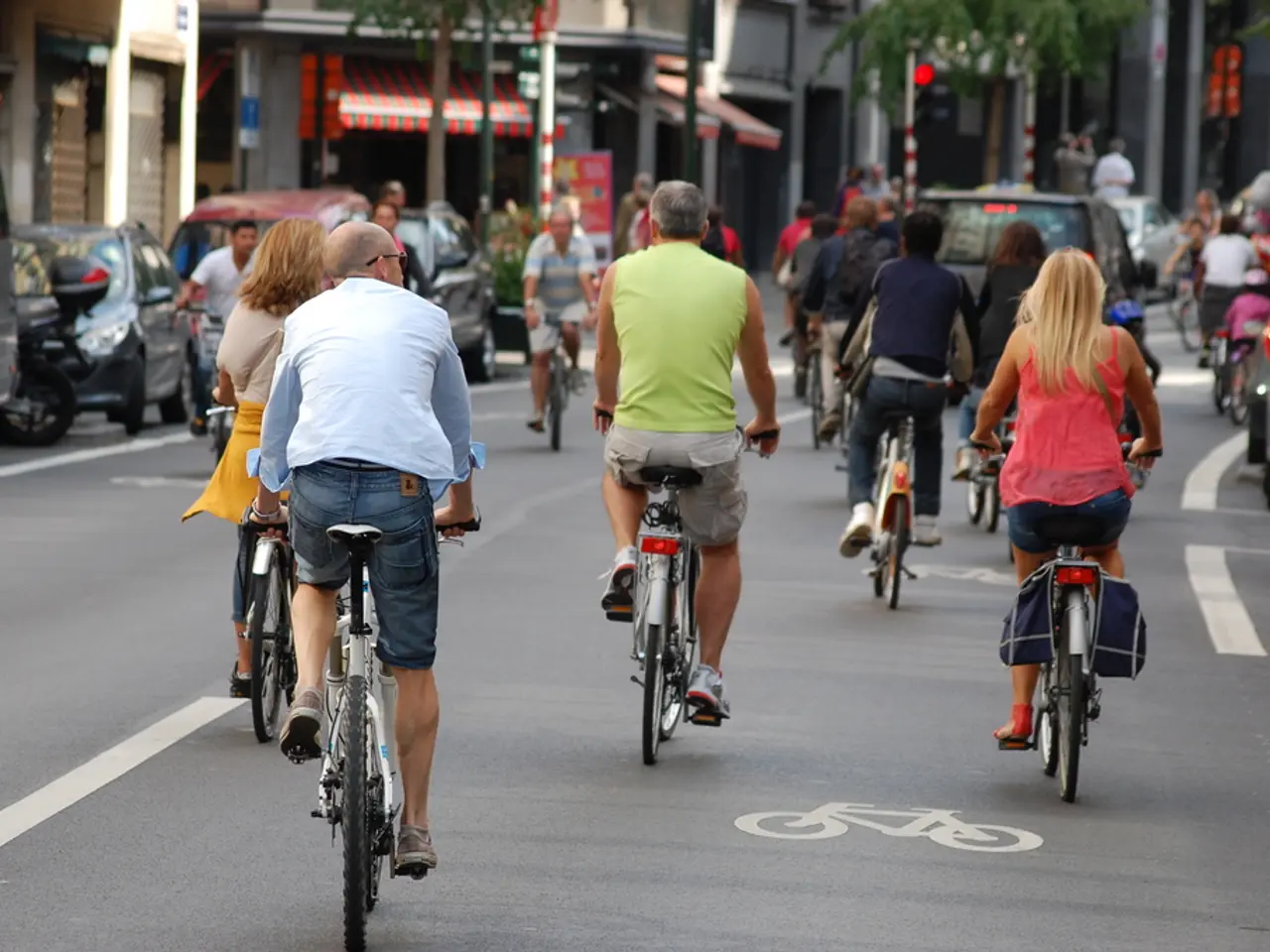
Most workers travel to their jobs primarily via automobile. - The majority of employees commute to their places of employment via car.
In the heart of Germany, Saxony-Anhalt is witnessing a growing emphasis on cycling as a mode of transportation, both for commuting and tourism. This shift is evident in the extensive network of cycle routes, such as the popular Elbe Cycle Route, and the expansion of cyclist-friendly accommodations. Furthermore, the region boasts infrastructure for e-bikes, with charging facilities readily available, particularly in Magdeburg [1].
However, when it comes to car usage, recent data specific to Saxony-Anhalt regarding traditional car commuting trends or the prevalence of electric car usage remains elusive. The prominence of cycling infrastructure and e-bike facilities suggests a move towards more sustainable and alternative commuting methods.
Regrettably, no definitive conclusions can be drawn about car usage trends (traditional or electric) based on the available information. For a more precise, quantitative analysis of vehicle and electric car use in Saxony-Anhalt, it is advisable to consult regional transport agencies or recent mobility studies.
Among the modes of transportation in Saxony-Anhalt, the bicycle takes a significant role. Last year, around 89,000 people used the bicycle for commuting, making it the second most common mode of transportation for employed people. Interestingly, the bicycle was also used by students, and it was particularly common among people aged 35 to under 45 and 55 to under 65.
Men and women in Saxony-Anhalt used bicycles for commuting almost equally frequently, with 9% of all employed people opting for this sustainable mode of transport. Moreover, more than half (52%) of all commuters needed between 10 and 30 minutes for their work trip, indicating the convenience of cycling.
Unfortunately, no data was provided about the number of people who walked or used public transportation, such as bus or tram, for commuting in Saxony-Anhalt. Additionally, no specific information was provided about changes in the use of cars or bicycles for commuting over time.
It's also important to note that last year, 67% of employed people in Saxony-Anhalt drove to work by car. Unfortunately, no specific information was provided about the use of electric cars for commuting in the region.
The figures for commuting in Saxony-Anhalt are based on the microcensus, an annual sample survey of private households. However, it's worth mentioning that the 2024 figures for commuting in Saxony-Anhalt are preliminary results.
In conclusion, Saxony-Anhalt is seeing a rise in bicycle commuting and tourism, with extensive cycling routes and e-bike infrastructure playing a significant role. However, the trend towards electric cars in the region remains undocumented in the current search results. For a more comprehensive understanding of vehicle and electric car use in Saxony-Anhalt, further research is necessary.
Community policy might consider expanding vocational training programs in the automotive industry for electric vehicle technicians, as there is a growing need for such expertise to maintain the increasing number of electric cars. Additionally, financial institutions could provide incentives for businesses offering vocational training in the transportation sector, helping to prepare workers for the shift towards more sustainable modes of transportation like cycling and e-bikes.




