
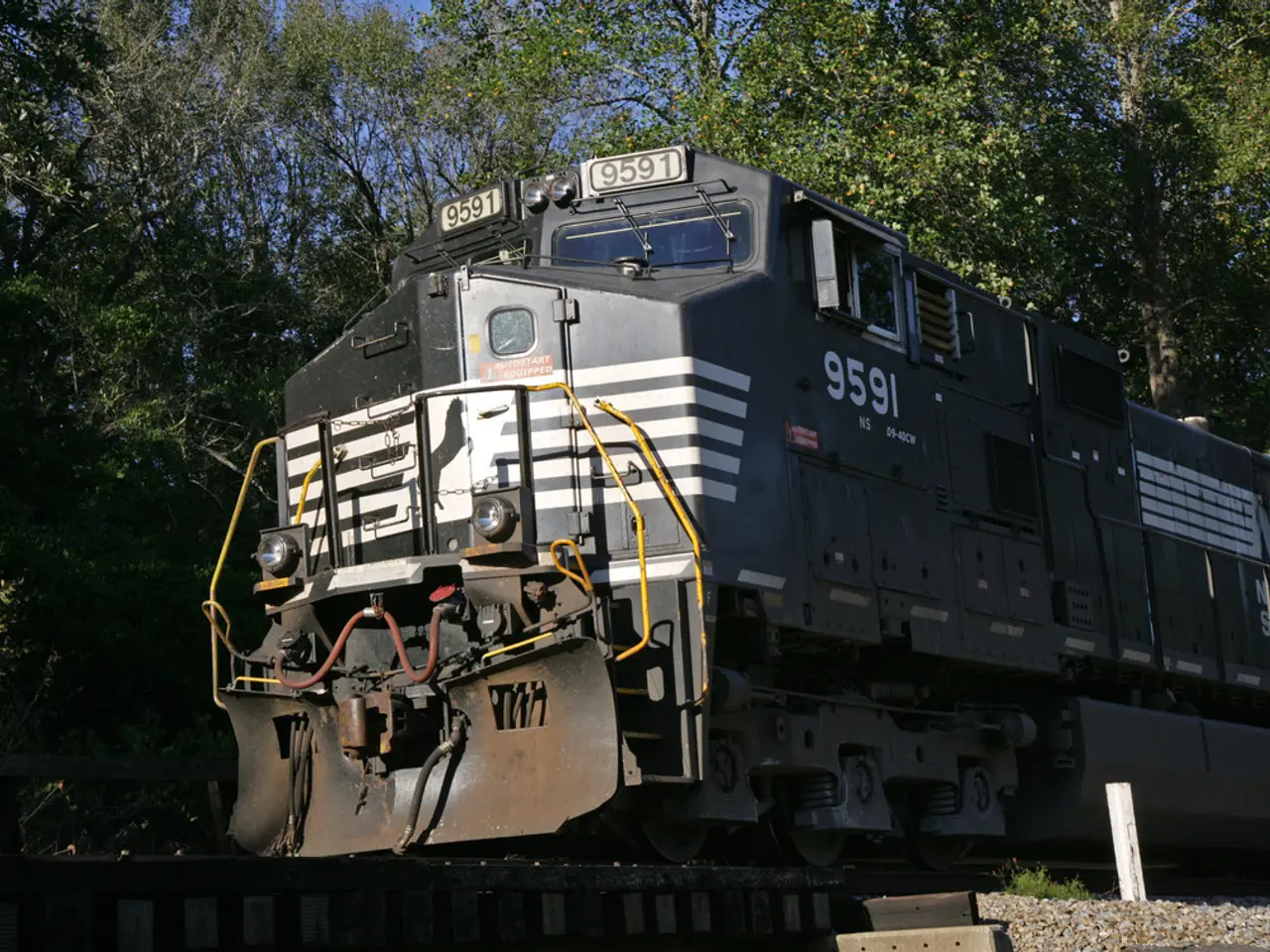
The Odenwaldbahn will transition towards eco-friendliness.
In the heart of Germany, the Darmstadt-Dieburg region is gearing up for significant changes in its transportation infrastructure, with the Odenwald Railway set to undergo extension and electrification.
The Odenwald Railway, often dubbed the backbone of mobility between Darmstadt and the Odenwald district, is poised to see improvements aimed at enhancing connectivity, reducing congestion, and boosting regional economic development. While specific details about the extension are yet to be disclosed, it is expected to build on existing Odenwald Railway routes, possibly linking underserved areas or improving connections to major transport hubs.
In line with Germany's commitment to sustainable transport, the electrification of the Odenwald Railway is also under consideration. Modern electrification uses overhead lines or third-rail systems, with overhead lines being more common for regional and mainline rail in Germany. While no specific recent plans for Odenwald Railway electrification in Darmstadt-Dieburg are detailed in the available sources, the general trend in German rail policy emphasizes network upgrades, electrification, and cleaner propulsion, with particular focus on reducing reliance on diesel.
The decision to make the Odenwald Railway fit for purpose is a significant step, according to the County of Darmstadt-Dieburg. This decision, made in collaboration with Deutsche Bahn subsidiaries InfraGO and DB Energy, and the Rhine-Main Transport Association (RMV), is part of a broader regional project that involves phased electrification, the introduction of modern rolling stock, and integration with broader transport networks.
In a separate development, the region has also been grappling with a series of traffic accidents. On June 5, 2020, a traffic accident occurred on Landgraf-Georg-Straße at the "Elisabethenstift / Woog" bus stop, injuring a passenger on a bus. This was followed by another accident on June 6, 2020, involving a car and a tram on the intersection of Frankfurter Straße / Landgraf-Georg-Straße.
The County Administrator, Lutz Köhler, has called for extensive electrification of the Odenwald Railway if there is a switch to battery-electric vehicles, emphasising the importance of the Odenwald Railway for the eastern part of the county. The First Deputy Administrator, Lutz Köhler, and Darmstadt's Transport Commissioner, Paul Georg-Wandrey, view the implementation of measures from the Erbacher Declaration as long overdue.
As the region moves towards a more sustainable and efficient transport system, the Odenwald Railway extension and electrification project are expected to play a crucial role. The exact details of these developments are yet to be announced, but the general trend in German rail policy and regional projects elsewhere in Germany suggest ongoing investments in electrification and cleaner propulsion technologies for improved sustainability and efficiency.
**Note:** This article is based on the provided bullet points and broader context, as no comprehensive information was available specifically about the Odenwald Railway extension, the details of triple traction trains, advanced propulsion technology, or electrification plans in the Darmstadt-Dieburg region.
*The location of the traffic accident on June 5, 2020, was at the "Elisabethenstift / Woog" bus stop on Landgraf-Georg-Straße. The traffic accident on June 6, 2020, involved a 35-year-old woman from Weiterstadt.*
*The expansion of the two crossing stations in Mühltal and Hetzbach is planned to allow for more frequent services.*
The Odenwald Railway's extension and electrification are anticipated to bolster regional economic development, thereby aligning with the broader transportation industry's advancement in the Darmstadt-Dieburg region. Simultaneously, this project, driven by collaborative efforts of Deutsche Bahn subsidiaries, Rhine-Main Transport Association, and the County of Darmstadt-Dieburg, will likely foster financial investments in cleaner propulsion technologies, contributing to the finance sector's commitment to sustainable practices.




